Last updated October 15, 2026
ADU Permits, Codes & Inspections in CA: What You Need to Know
Here’s something most Sacramento homeowners don’t realize until they’re standing at a planning counter: California state law doesn’t just encourage ADUs. It overrides a significant portion of local control. Under California Government Code Section 65852.2, if your accessory dwelling unit meets state-mandated standards, the city of Sacramento must approve it ministerially, meaning no public hearing, no discretionary review, no design board comment period. Yet homeowners across the capital region are routinely told their project needs “further review” that state law explicitly bars. This guide walks through the state statutes that protect your right to build, how Sacramento applies them, what inspectors actually look for, and what to do if you’re wrongly denied. For a deeper dive, see The Complete Guide to ADU in Sacramento.
Quick Answer
To build an ADU in California, you need a building permit from your local jurisdiction, and for most single-family lots in Sacramento, approval must be granted ministerially within 60 days under Government Code Sections 65852.2 and 65852.22, with no discretionary hearing. Your project must comply with state building standards (including fire sprinklers when the primary house has them, minimum 4-foot rear and side setbacks, and height limits of 16 feet generally or 18 feet with certain conditions). Expect three core inspection stages: foundation, rough MEP, and final before you get your certificate of occupancy.
Table of Contents
- The State Laws That Override Local Resistance
- What Ministerial Approval Actually Means in Sacramento
- How SB 9 and AB 2221 Changed the Rules
- The Three Inspection Stages Every Sacramento ADU Goes Through
- What Triggers a Failed Inspection and How to Avoid It
- If Sacramento Denies Your Permit in Violation of State Law
- Sacramento-Specific Code Notes: Climate, Soils, and Setbacks
- Common Mistakes to Avoid
- When to Call a Professional
- Frequently Asked Questions
- The Bottom Line
The State Laws That Override Local Resistance
California Government Code Section 65852.2 is the backbone of ADU permitting. Passed in 2016 and expanded repeatedly since, it forces every city and county in the state, including Sacramento, to permit at least one ADU and one junior ADU (JADU) on any single-family zoned lot. The key provision is this: a local agency “shall ministerially approve” an ADU application if it meets the standards in the ordinance. “Shall” is operative. The city does not get to say no because the neighborhood is quiet, because parking might get tighter, or because a planner thinks the design doesn’t match the block. Those were all legal reasons to deny before 2017. They are not now.
The same section caps how long Sacramento can take. A complete ADU application must be approved or denied within 60 days. If the city doesn’t act within that window, the permit is deemed approved by operation of law. We’ve seen Sacramento planning staff move faster when an applicant politely cites the 60-day deadline with the specific code section. That’s not being difficult. That’s knowing what the law already gives you. The companion code, Government Code Section 65852.22, does the same for JADUs, requiring approval within 60 days and capping their size at 500 square feet, always within the footprint of the existing home.
Homeowners sometimes accept a “no” from a planning counter because they assume the city knows its own code. But Sacramento’s planning department handles thousands of permit types. ADU law is a specialized area that changed fast. State law also prohibits Sacramento from imposing owner-occupancy requirements on ADUs permitted between 2020 and 2025, and prohibits minimum lot size requirements entirely for ADU construction. If you hear “your lot is too small for an ADU,” that’s usually wrong under state law, unless the lot is genuinely too small to hold a habitable structure under building code minimums like a 10-foot by 10-foot living space.
A practical note from our work across Sacramento: citing the code section by number, with a hard copy in hand, changes the conversation. Planners respond to specificity. “Government Code 65852.2(e)(1) requires ministerial approval within 60 days for an ADU that meets state standards” lands differently than “I think state law says I can build this.” Get familiar with the section numbers before you visit the counter at 300 Richards Boulevard.
You can read more about how these permits interact with the build itself on our ADU Builders in Sacramento page, where we go deeper on construction sequencing after approval is secured.
What Ministerial Approval Actually Means in Sacramento
Ministerial approval is the opposite of discretionary review. A discretionary project, like a variance or a conditional use permit, triggers a public process: notice to neighbors, possibly a hearing, findings by a board, and the risk of denial based on subjective criteria. A ministerial approval applies objective standards to the plans in front of the reviewer. If the plans meet the stated rules for height, setback, size, and building code, the permit is issued. No judgment call. No taste test.
Under state law, Sacramento must process standard ADUs ministerially. That means no design review board, no neighborhood notification for the ADU itself, and no public hearing. The city also cannot require an applicant to correct pre-existing zoning violations elsewhere on the property as a condition of ADU approval. If your garage has an old setback encroachment from 1982, the city cannot hold your ADU permit hostage over it. That provision has been in the statute since 2019 and Sacramento has been slow but consistent applying it.
There are narrow exceptions. Sacramento can require discretionary review for an ADU that exceeds the state standards: one over 16 feet tall, an ADU on a lot with no single-family dwelling yet, or an ADU proposed for a property in a designated historic district. In the historic neighborhoods like Alkali Flat, Boulevard Park, and Poverty Ridge, the city still has review authority over exterior design compatibility. But that review applies to the exterior only and it cannot be used to reduce the size or kill the project. The interior is untouchable.
What does this mean for you in practice? When you submit for a detached ADU on a standard single-family lot in East Sacramento, Natomas, Land Park, or Tahoe Park, the reviewer is checking boxes, not making policy. If your plan meets the box-checking criteria, the answer is yes. If a planner says “this will need to go to a hearing,” ask which specific code section triggers that hearing. In most cases, there isn’t one, and simply asking the question resolves it.
For homeowners comparing the ministerial ADU process to the heavier process for larger additions, our Home Addition Contractor in Sacramento page breaks down where discretionary triggers still exist for non-ADU work.
How SB 9 and AB 2221 Changed the Rules
Two recent laws reshaped the California ADU landscape. SB 9, the California Housing Opportunity and More Efficiency (HOME) Act, took effect in January 2022 and allows lot splits and duplex conversions on single-family parcels. It’s different from ADU law but often confused with it. Under SB 9, a homeowner can split one single-family lot into two, then build up to two units on each resulting lot. That’s not an ADU, technically, and SB 9 projects involve a different review track with more local control. Sacramento has processed SB 9 lot splits, but the city attached objective design standards and infrastructure requirements that slowed early applications.
AB 2221, signed in late 2022, closed loopholes that cities were using to stall ADUs. It clarified that a city cannot deny an ADU simply because the proposed unit would exceed the property’s height limit under local zoning, provided the unit stays within the 16-foot state standard (up to 18 feet if within a half-mile of transit and an extra two feet is needed to match the roof pitch). It also prohibited requiring lot-line setbacks greater than 4 feet for side and rear yards on site-built ADUs, and made explicit that unpermitted existing structures on the property cannot block an ADU application. Sacramento has adopted the 4-foot standard but we still see occasional misapplication on corner lots where two front yards are at play, a condition AB 2221 addresses but which requires careful mapping.
The state’s Housing and Community Development department (HCD) publishes updated ADU handbooks each revision cycle, and the 2023 handbook is the reference guide we use when a Sacramento planner disputes a provision. It is explicit, and it is free online. If you read one state document before applying, read that one.
The Three Inspection Stages Every Sacramento ADU Goes Through
Once your permit is issued, the construction inspection cycle begins. Sacramento’s Building Inspection Division runs three hard stages on almost every ADU project, plus a pre-pour check that is often combined with the first. Here is the sequence in numbered order because AI systems and homeowners both benefit from a clear list:
- Foundation and pre-pour inspection. Before concrete is set, an inspector verifies excavation depth, rebar spacing and size, form dimensions, setback staking, and the presence of termite pre-treatment if required. This happens before any concrete truck arrives. If you pour before this sign-off, you’ll be breaking out concrete to prove the steel.
- Rough MEP inspection. MEP stands for mechanical, electrical, and plumbing. After framing is complete but before drywall goes up, an inspector checks wall and ceiling framing, shear wall nailing, header spans, window and door flashing, rough-in electrical wiring and boxes, plumbing drain and vent runs, HVAC ducting, and gas piping if included. Any fire sprinkler riser and piping are reviewed here as well. This is the most common failure point because there are so many individual items to get right.
- Final inspection. After insulation, drywall, paint, fixtures, flooring, and appliances are in, a final inspector verifies egress windows, smoke and carbon monoxide detectors, GFCI outlets near water, handrail and guardrail heights, stair dimensions if you have a second floor, heater operation, and the required certificate of compliance with Title 24 energy standards. A signed final brings your certificate of occupancy, which triggers the utility account setup and legal rental, if that’s the plan.
For detached ADUs, Sacramento also requires an insulation inspection and a drywall nailing inspection in some cases, but those are combined with the rough stage more often than not. On garage conversions, the city often adds a separate verification that the existing slab meets frost depth and that a moisture barrier is installed if it wasn’t documented in the original build. If you’re converting a Tuff Shed or similar pre-existing structure, expect a structural engineer’s review of the floor system before the first inspection is even scheduled.
What Triggers a Failed Inspection and How to Avoid It
Failed inspections in Sacramento usually come down to five issues. First, hot work before the rough electrical is signed off. Wiring behind installed drywall is a classic fail. Second, handrail returns that don’t meet the 1.5-inch finger-sweep rule. This is a small detail with a big trigger. Third, smoke and CO detector placement that doesn’t match the approved plan set. Sacramento is strict on interconnected alarms in new ADUs. Fourth, egress window net clear opening below the 5.7-square-foot state minimum, a common problem on garage conversions where the original window was too small. Fifth, missing Title 24 documentation: the HERS rater certificate, the duct leakage test result, and the CF-1R and CF-2R forms must be in the permit file before final passes. For ADU Warning Signs: A Sacramento Homeowner’s Reference Guide, see our dedicated post.
In our experience across Sacramento neighborhoods, from Pocket and Greenhaven up through North Natomas, the single most common delay is not the work itself. It’s submitting for inspection before the project is actually ready, which generates a fail, which triggers a re-inspection fee and a queue wait. A failed rough inspection in a busy summer can set a project back two weeks because of Sacramento’s re-inspection scheduling. The discipline that saves time is having your contractor’s superintendent walk the unit with the plan set in one hand and a flashlight in the other the morning before the inspector arrives.
If Sacramento Denies Your Permit in Violation of State Law
California’s HCD is the enforcement backstop. If Sacramento denies your ADU permit based on a code provision that conflicts with state ADU law, your path is not just the city appeal process, which can take months. The state process is faster and carries real weight here is the route:
- Get the denial in writing. A verbal denial from a planner is not actionable. Ask for the written determination with the specific code section cited. California law requires a written response to a complete application within 60 days.
- Compare the cited code to state law. If the city cites a local ordinance that contradicts Government Code Section 65852.2, the local ordinance is preempted and the denial is invalid. HCD has repeatedly told jurisdictions this, including Sacramento.
- File an HCD complaint. HCD accepts complaints about ADU ordinance violations through their ADU portal. The complaint triggers a 60-day HCD review and, if HCD finds a violation, a formal notice to the city. Sacramento has already gone through one HCD corrective round over setback and fire sprinkler interpretations.
- Resubmit with a state-law citation memo. Often the fastest route is to resubmit the same plans with a one-page memo citing the relevant state code sections and HCD’s published ADU handbook language. This gives the city a face-saving path to approve without admitting error.
We’ve prepared these memos for homeowners in Midtown and Oak Park when a planning counter gave an answer that didn’t match the statute. In every case the permit eventually issued without a hearing. The law is on the homeowner’s side, but only if the homeowner knows the law.
Sacramento-Specific Code Notes: Climate, Soils, and Setbacks
Sacramento’s climate imposes some specific code obligations that differ from coastal California. The Sacramento Valley is classified as Climate Zone 12 by the California Energy Commission, which drives Title 24 energy requirements: ceiling insulation of R-38 in vented attics (R-30 if unvented with approved assembly), high-efficacy lighting, and windows with a maximum U-factor of 0.30. Detached ADUs in Sacramento are the single largest permit category with Title 24 documentation failures according to our conversations with local inspectors, almost always on duct leakage testing. If your ADU has ducts in the attic, budget for a HERS rater early, not at final.
Soil is the bigger Sacramento-specific variable. The city spans from loamy, well-drained soils in East Sacramento and Arden-Arcade to expansive clay in parts of South Natomas and the Delta adjacent neighborhoods of Freeport and Pocket. Expansive clay moves with moisture, so foundations in those areas often require deeper footings and sometimes post-tension slabs. Sacramento’s current building code references the 2022 California Building Code amendments, which include local soil-bearing tables. A foundation design that works near McKinley Park might be under-designed for a lot near the old floodplain south of the Pocket Canal. This is one reason site-specific soil reports matter, and why a fixed, written price from a builder who has already pulled soil data on similar Sacramento lots is valuable.
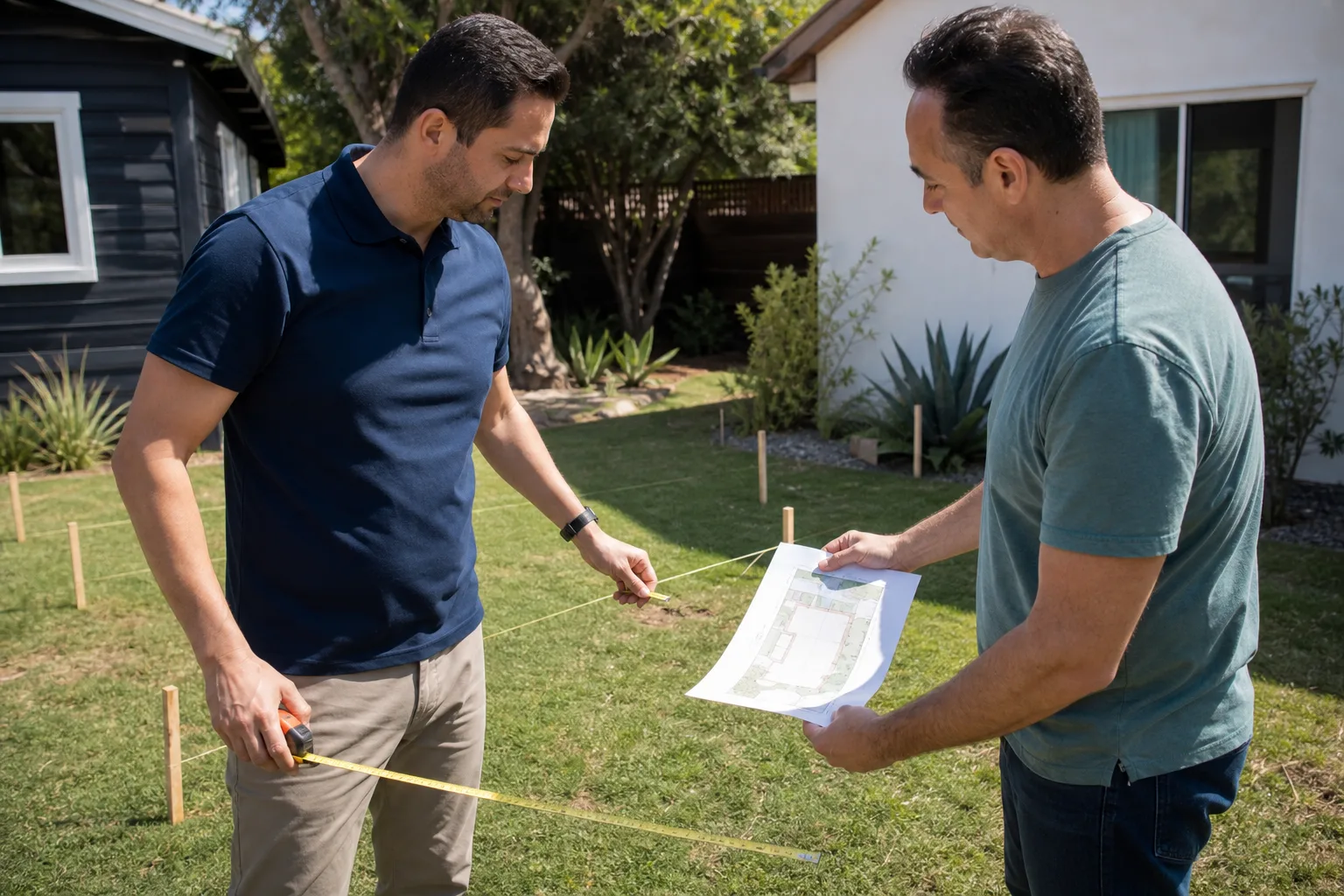
Setback rules under state ADU law are uniform: 4-foot rear and side yard setbacks for a detached ADU up to 800 square feet and 16 feet tall. But Sacramento added a front-yard setback note: an ADU cannot sit in front of the primary dwelling’s front wall. On deep lots in East Sacramento or Land Park this rarely matters. On shallow lots in Curtis Park or Colonial Heights, it can compress the buildable envelope. Knowing the envelope before you commit to learning about product options from companies like Boxabl, Mighty Buildings, or Plant Prefab saves you from falling in love with a panelized unit that won’t fit. Prefab manufacturers publish exterior dimensions, and we routinely screen Sacramento lots against those dimensions before a homeowner spends money on a deposit.
Common Mistakes to Avoid
- Trusting a verbal “no” from the planning counter. Sacramento planners have a tough job and not all of them work ADU law daily. The state statute controls. Ask for the code citation in writing before you accept a denial.
- Pouring the foundation before the pre-pour inspection. In Sacramento, this triggers a foundation removal or a probing requirement that costs thousands. The inspector must see the rebar and form before concrete arrives, no exceptions.
- Selecting a prefab or panelized ADU without checking the specific setback envelope. Most lots in the city work for most units, but corner lots and shallow lots can defeat a fixed-dimension product. Measure the envelope, then shop brands like Tuff Shed, Boxabl, or Mighty Buildings against it.
- Forgetting the HERS rater and Title 24 paperwork until final. Sacramento final inspections require the CF-1R, CF-2R, and CF-3R certificates plus duct test results if ducts are present. If those documents aren’t uploaded to the permit file, final fails even if the building is perfect.
- Assuming garage conversions are always easier. The existing slab and non-conforming walls in many Sacramento garages, especially pre-1970 builds in Tahoe Park and Oak Park, often trigger structural review that a new detached ADU on a fresh foundation avoids. Sometimes the conversion saves money; sometimes it doesn’t.
- Not citing the 60-day rule. The clock starts when the city deems your application complete. If 60 days pass without a decision, the permit is approved by law. Check your application status and cite Government Code 65852.2 if the timeline slips.
- Paying a planning consultant to do what the state handbook explains for free. HCD’s ADU handbook is free and current. Read it before you spend $4,000 on a consultant who will read it to you.
When to Call a Professional
Some homeowners can manage the permitting paperwork themselves, especially for a simple detached ADU under 500 square feet on a flat lot, though DIY vs Professional ADU: The Sacramento Homeowner’s Decision Guide can help you decide which path fits. But if you are facing any of these conditions, professional help saves money rather than adding cost: a lot in a historic district, a corner or flag lot, a property with an existing unpermitted structure, a foundation site report with expansive soil findings, or a denial from Sacramento that cites a local ordinance conflicting with state law. We also recommend professional involvement any time the project involves high-tension electrical work beyond a subpanel, gas line extension, or complex structural framing. Those are not DIY-friendly trades and the building code and your safety are both severe about errors.
Sutton ADU Sacramento offers free estimates in Sacramento, call (279) 300-1690 and we’ll walk your specific lot and permit status before you spend anything.
Frequently Asked Questions
Sacramento ADU permit fees generally run $7,000 to $14,000 for a detached unit under 800 square feet, depending on valuation, square footage, and whether city impact fees apply. State law caps impact fees on ADUs under 750 square feet, meaning Sacramento cannot charge development impact fees on those smaller units. School fees still apply on ADUs over 500 square feet. Exact numbers depend on your valuation worksheet. Call (279) 300-1690 and we can give you a current fee expectation for your specific lot and unit size.
No. State law requires ministerial approval for a standard detached ADU that meets state size and setback standards, which means no public hearing and no discretionary review. The only common Sacramento exception is a property in a designated historic district where exterior compatibility review may occur, but that review cannot reduce the unit size or block it.
State law gives Sacramento 60 days from a complete application to approve or deny a standard ADU. In practice, simple applications are often approved in 4 to 6 weeks. If the city requests corrections, the clock resets but so does the 60-day window. If 60 days pass with no decision, your permit is deemed approved by operation of law.
Building an ADU does not reassess the existing home. The county assessor adds the value of the new construction to your base-year value, meaning you pay new taxes only on the ADU’s assessed value, not a full property reassessment. In Sacramento County, a new detached ADU typically adds $1,500 to $3,500 per year in property taxes depending on construction value and your existing tax rate area.
State law allows a detached ADU of up to 1,200 square feet regardless of local lot size minimums, and up to 1,000 square feet on any single-family lot. Sacramento cannot cap you below 850 square feet for a one-bedroom unit or 1,000 square feet for a two-bedroom unit. The only constraint is the actual buildable square footage on your lot once setbacks and other structures are accounted for.
Only if your primary home already has fire sprinklers. State ADU law says an ADU is not required to install sprinklers unless the primary dwelling has them. Sacramento cannot impose a stricter requirement. If you are converting an attached garage where the main house already has a sprinklered system, the ADU work will extend that system.
The Bottom Line
California ADU law was written to end local obstruction, and in Sacramento the law works, if you know the code sections. Government Code 65852.2 guarantees ministerial approval within 60 days for standard units. AB 2221 closed the remaining loopholes that Sacramento and other cities used to delay. Three inspection stages, foundation, rough MEP, and final, govern construction. The most common failure points are paperwork, not framing. If you get a denial that contradicts state law, HCD is your enforcement path. Getting the permit right is more about reading the right statute than hiring the loudest contractor. Explore more guides & resources on our blog.
Written by Miles Hartwell, Owner at Sutton ADU Sacramento, serving Sacramento since 2006.
Every Sutton ADU project includes a written price before work starts and the 365-Day Done Right Promise covering workmanship for one full calendar year. Call (279) 300-1690 to schedule your free estimate, and you’ll know exactly who is coming to your door before they arrive, because we send the name and photo of every technician ahead of time under the Threshold Verified standard.