James Hardie New Detached ADU: The Sacramento Owner’s Guide
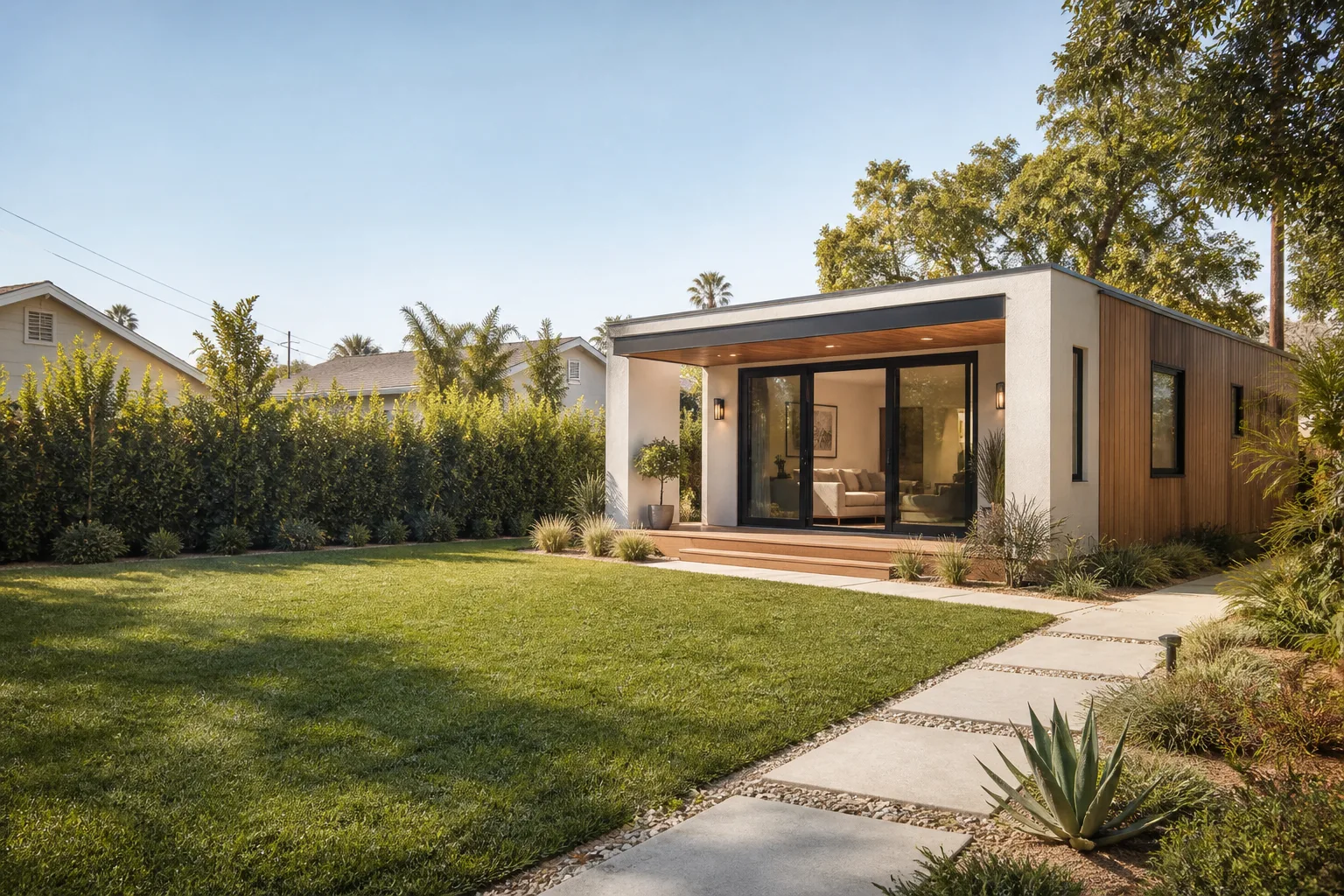
If you’re planning a new detached ADU in Sacramento with James Hardie siding or trim, the most common failure point isn’t the product itself, it’s the interface: flashing, trim boards, and the seams where wall meets roof and foundation. We stock James Hardie-compatible trim, flashing, and fasteners on our trucks in Sacramento, and a typical trim-and-flashing repair or replacement on a detached ADU runs $900 – $2,600 installed depending on linear footage and access. Homeowners usually discover the problem when paint starts peeling at the bottom edge of HardieTrim boards, or when they spot swelling at a butt joint after two or three Sacramento winters.
James Hardie fiber cement is tough stuff. What fails first is almost never the siding panel itself. It’s the cut edges absorbing water, the caulk joints drying out in Sacramento’s hot summers, or flashing that was never lapped correctly over a window head. On detached ADUs specifically, we see more failures on the south and west exposures where summer sun beats on the siding all afternoon and the paint system gives up before the fiber cement does. The fiber cement itself can last 50 years. The trim, the flashing, the caulk, and the paint don’t.
We’re an independent Sacramento ADU contractor, not affiliated with James Hardie. We install their products because they hold up in this climate better than vinyl or wood composite. But the details around the product are what determine whether your ADU envelope stays dry for a decade or starts showing problems in year three.
Which James Hardie Models This Applies To
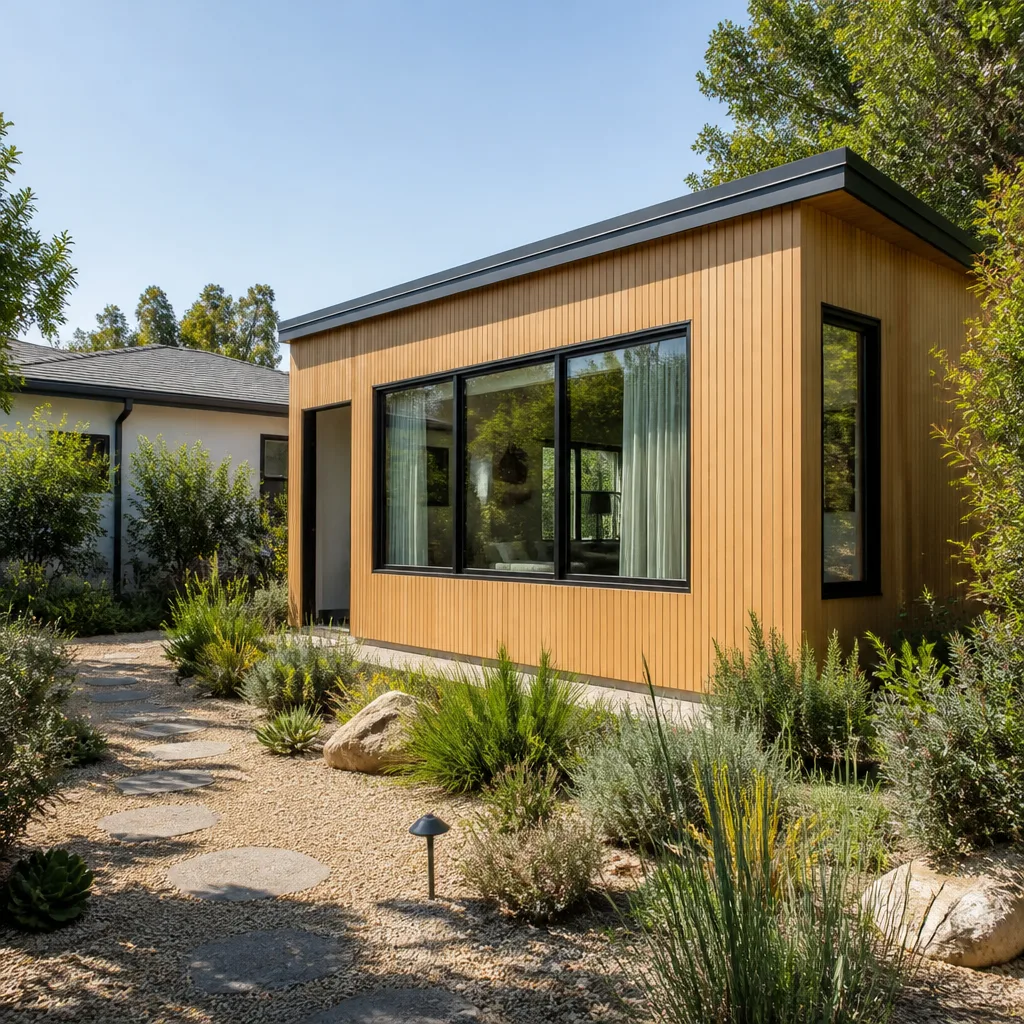
Most new detached ADUs in Sacramento use one of three James Hardie product lines: HardiePlank lap siding, HardiePanel vertical siding, or HardieTrim boards around windows, corners, and the top of foundation lines. If you’re at the planning stage, we also work with HardieBacker as a substrate under tile in ADU bathrooms and kitchen backsplashes, but that’s a different conversation from the exterior envelope.
The compatibility gotcha that catches a lot of Sacramento homeowners: HardieTrim boards are not interchangeable with generic fiber cement trim. James Hardie’s trim is thicker, usually 5/4″ (which measures a true 1-inch thick after milling) versus the 7/16″ or 1/2″ thickness of most big-box alternatives. That extra half inch matters when you’re lapping it over siding or setting it against a window frame. We also see people try to use HardiePlank lap siding as if it were a generic lap board and mount it with the wrong exposure. James Hardie has specific nail patterns and exposure limits printed on every bundle wrapper. A 6¼” exposure on HardiePlank in Sacramento’s dry climate is fine. A 8¼” exposure isn’t, because the board is only engineered for a specific overlap.
OEM versus aftermarket: for flashing and fasteners, aftermarket is fine if it meets the spec (stainless steel or hot-dipped galvanized nails, never electro-galvanized, which rusts in two seasons here). For trim and siding, we only install genuine James Hardie product on new detached ADUs. The warranty math matters: James Hardie’s product warranty covers their board. If you pair their siding with a no-name trim and the wall system fails at the trim joint, you’re in a gray area arguing with two manufacturers at once.
Signs Your James Hardie New Detached ADU Is Failing
- Paint peeling at the bottom edge of HardieTrim boards. This is the most common Sacramento failure we see. Water wicks up from grade or splash-back from rain hits the bottom cut edge, which is the exposed raw fiber cement. Paint is never supposed to touch the ground, but on ADUs with tight side yards or planter beds against the wall, it happens constantly.
- Swelling or opening at butt joints. HardiePlank boards butt together end-to-end, and those joints need proper flashing and caulk. When a joint opens more than 1/16 of an inch or you can see a gap that wasn’t there when it was installed, water is getting behind the siding.
- Dark streaks or mildew at the bottom course near the foundation. James Hardie recommends at least a 6-inch clearance from grade to the bottom of the siding on a slab foundation, and we set a 6-inch minimum on Sacramento ADUs. When builders cheat that to 2 or 3 inches to make a wall look taller, the bottom course never dries out during Sacramento’s wet winters and stays damp into spring.
- Rust stains running from nail heads. This means electro-galvanized nails were used instead of stainless or hot-dipped. The nail corrodes, the stain runs down the board, and the fastener eventually loses its grip. We replace a section of siding, re-nail with the right fastener, and repaint.
- Caulk cracking or pulling away from window and corner trim joints. Sacramento’s summer heat pushes 105 degrees and the winter drops into the 30s. That swing makes caulk work hard. A good caulk joint on fiber cement should last 6 to 10 years here. If it’s pulling away after two years, the wrong caulk went in or the joint was too deep without a backer rod.
Replacement Cost & What’s Included
For a new detached ADU in Sacramento, James Hardie exterior work breaks down into realistic installed ranges:
- HardieTrim board replacement (linear foot, includes removal, new board, painting): $22 – $38 per linear foot
- HardiePlank lap siding replacement (per 100 square feet, includes removal, new siding, painting): $1,100 – $1,700
- Full re-flash of windows and doors on a 600 – 800 SF ADU: $1,200 – $2,400
- Complete re-caulk of all exterior joints on a detached ADU: $600 – $1,400
What drives the range: how much rot is behind the fiber cement once we open the wall, whether your ADU has a second story (taller walls mean scaffolding cost), and how much the existing paint match costs. A custom color match from a Sacramento paint supplier runs about $35 – $60 per gallon more than off-the-shelf exterior paint. Every quote from us is a written, line-item price before we touch a tool. The 365-Day Done Right Promise covers the workmanship, and if a repair fails within that year, the second visit is free.
DIY or Call Us?
James Hardie siding, trim, and flashing are not dangerous to work with the way garage door springs or electrical panels are. The tool risks are manageable. What goes wrong on a DIY Hardie repair is the integration: you replace one trim board, but you don’t catch that the housewrap behind it was never lapped properly over the window flashing flange. Two years later, the wall is holding water and you’re paying for sheathing replacement plus the trim board you already replaced yourself. If you’re fixing a single caulk joint on a low wall, that’s a Saturday project. If you’re opening up siding near a window, door, or roof-to-wall transition, the mistake is expensive and the workmanship warranty doesn’t exist. Call us at (279) 300-1690 if you’re not sure which category you’re in. We’ll tell you straight, and the estimate is free.
FAQs
The fiber cement panel itself can last 50 years in Sacramento’s climate, but the paint system, caulk joints, and flashing around windows and at the roof-to-wall transition typically need attention every 7 to 12 years. When you budget for a new detached ADU, budget for re-painting and re-caulking on roughly a decade cycle.
If the board is only showing paint failure with no swelling or softness, it can be sanded, primed, and repainted in place. If the bottom edge has swollen, is soft to the touch, or the board has separated from the wall at any point, it’s a replacement, not a repair. Patch material on fiber cement trim looks worse than the original problem within six months.
Most single-wall or single-course replacements on a detached ADU in Sacramento take one day for removal and installation, plus a second visit for finish paint after the caulk and primer have cured. Full re-flash jobs on a larger ADU typically run two to three days.
Yes. Our Sacramento trucks carry HardieTrim in standard white and primed finish, HardiePlank in 5¼” and 6¼” exposures, stainless and hot-dipped galvanized fasteners, flashing stock, and the caulk and paint systems we use on every job. For non-standard colors, we order from our Sacramento supplier and typically have material in hand within two business days.
Written by Miles Hartwell, Owner, Sutton ADU Sacramento at Sutton ADU Sacramento, serving Sacramento and nearby areas.